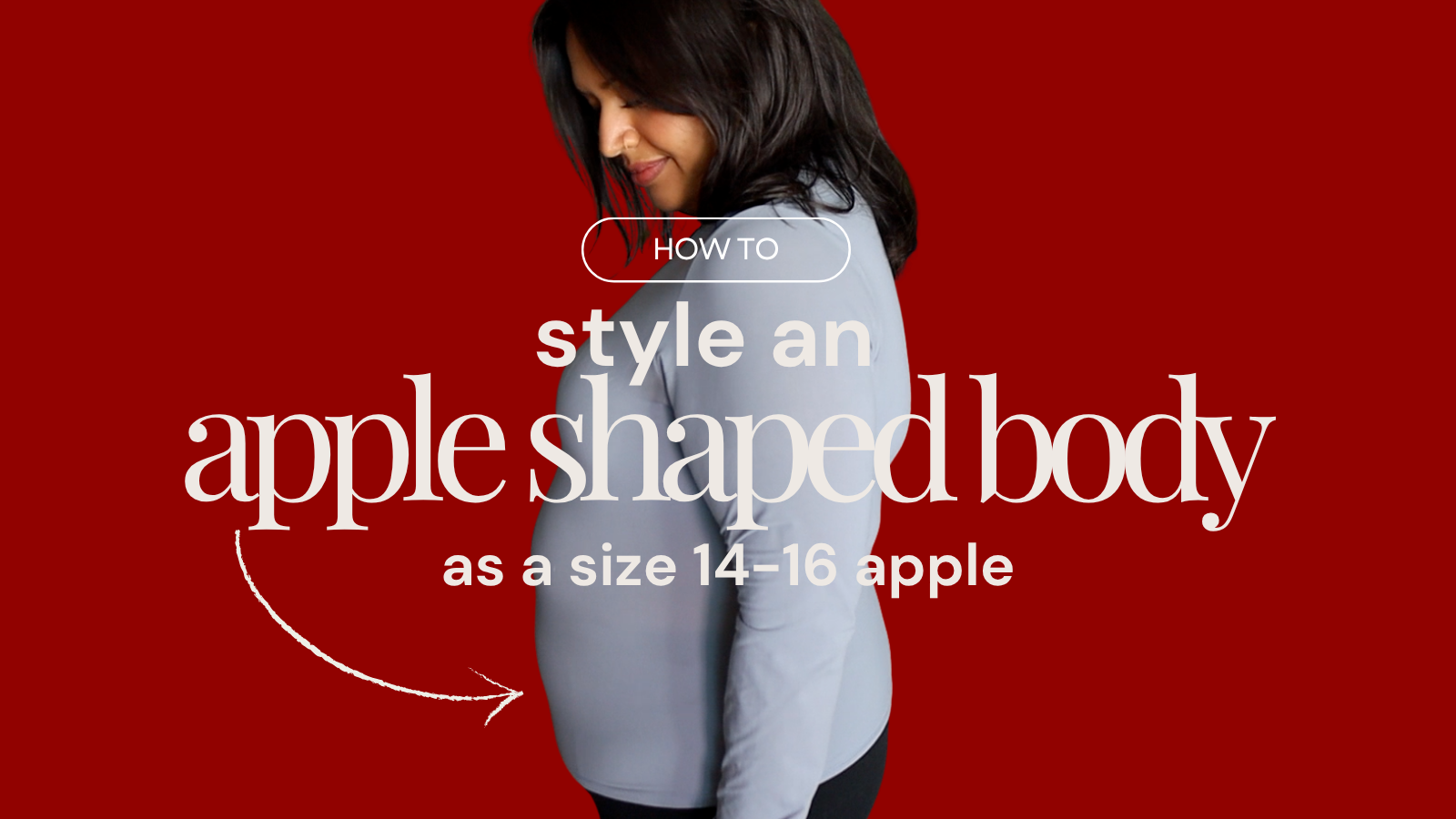
Okay, let’s start with the thing I wish someone had said to me years ago: the reason you’ve been confused about style your whole life isn’t because you’re hard to dress. It’s because almost all plus-size style content is written for hourglass bodies or pear shapes — and if you’re apple-shaped, you’ve been applying advice that was never designed for you in the first place. THIS is How to Dress an Apple Shaped Body.
I’ve been apple-shaped my whole life. I’m now a size 14-16 depending on the brand and the particular chaos of whoever designed the sizing that season. I also have Hashimoto’s and PCOS, which means my belly has been a major character in my style story for years. Not just because of the apple body shape, but because hormonal fluctuation is real and some weeks my body apples more than normal. And through all of it, I’ve been figuring out what actually works.
This is not a guide full of phrases like “elongate your silhouette” or “draw the eye upward.” I’ve come to realize that kind of language deeply exhausting and also, usually wrong. This is what actually works, explained from a person who actually lives in this body type, talking to another person who also lives in this body.
PART 1: What Apple Shape Actually Means
Apple shape means your weight sits primarily in your midsection (your belly, your chest, and your upper body carry more volume relative to your hips and legs). Your waist is not your smallest point. You might have slimmer legs that feel “out of proportion” with your upper body. Your bust is often full. Finding bottoms that fit without gaping at the back is also a nightmare.
Now, within apple shapes there’s a lot of variations. Some of us are apple-shaped but carry more in the belly than the bust. Some of us are full through the chest and arms. Some of us have the apple belly but also significant hips — which puts us in kind of an apple-pear crossover. Size 14-16 specifically means we’re often in the range where regular plus-size clothing works sometimes but extended sizing doesn’t always apply — a complicated middle zone that means we’re trying on a lot of things that claim to fit us.
What apple shape is not: a problem. It’s a body type that requires understanding — and once you understand how it works, styling becomes genuinely easier. The Apple Shape Principle: The goal is not to make your body look like a different body. The goal is to create balance, and for apple shapes, usually means building visual weight in the lower half to balance the visual weight in the upper half. That’s it. That’s the whole theory.

PART 2: Bottoms, The Category That Changes Everything
Bottoms are where apple-shape dressing either clicks or completely falls apart. Because the issue with apple-shaped bodies is that our waists and our hips are not in the proportion that most pants are drafted for. Standard pants assume a significant waist-to-hip ratio — they’re drafted for bodies where the hips are measurably wider than the waist. Ours aren’t. So we end up with gaping waistbands, or we size up to fit the belly and the hips are enormous, or we find the hips and the waist gaps at the back.
Trousers & Pants
WHAT WORKS FOR APPLE SHAPES: Wide-leg trousers with a mid-to-high rise. The wide leg creates visual volume in the lower half, which balances the belly. The key is the rise: you want at least a mid-rise, ideally high-rise, because a low-rise will cut right across your belly and create a muffin-top situation that is purely a waistband problem, not a body problem. Wide leg + high rise = the apple shape trouser formula.
WORKS FOR APPLE SHAPES: Straight-leg jeans in a dark wash. The straight leg doesn’t add drama but it doesn’t fight against you either. Go for a high-rise straight leg in a stretch fabric that has some structure to it. Soft denim that has no recovery will sag and bag and look sloppy. You want a fabric that holds shape.
ALMOST NEVER WORKS: Low-rise anything. Low rise was designed for bodies with a defined waist smaller than the hips. On apple shapes, it creates a waistband that cuts directly across the widest part of our belly, which is uncomfortable and also just doesn’t look like it was intentional. High rise always, or at minimum mid-rise.
Skirts
For skirts, the same principle applies. You want volume in the lower half. Midi-length A-line skirts work, but not the kind of A-line that starts flaring immediately from a fitted waist, because apple shapes usually don’t have that fitted-waist to work with. The better option: a skirt that skims over the belly and then flares out from the hip area. Wrap skirts can be brilliant if the tie is at the side, and the fabric has enough weight to drape rather than cling.
PART 3: Tops
Top Length — The Rule That Actually Matters
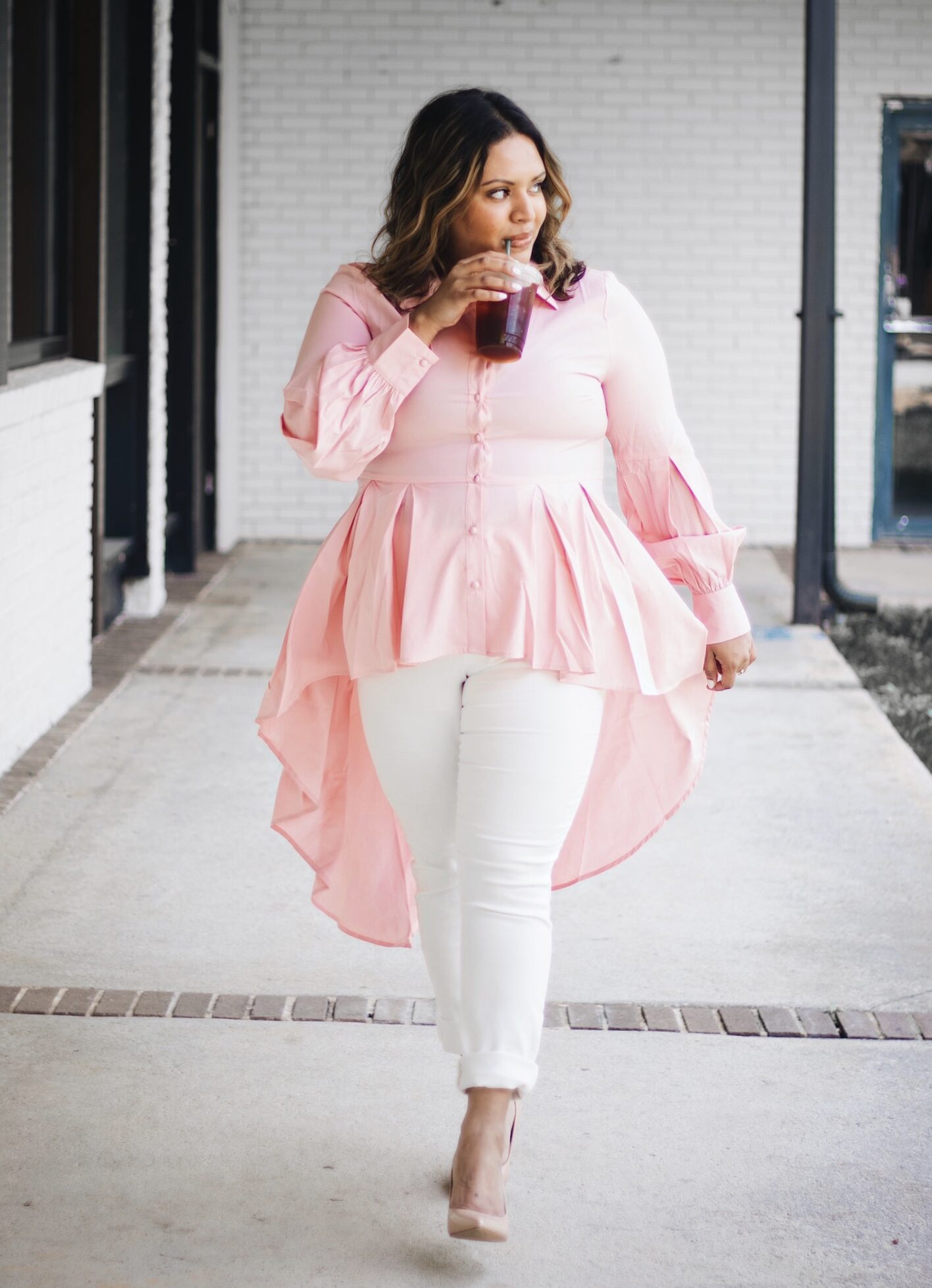
Here is the most useful thing I can tell you about tops as an apple shape: the hem of your top is a visual line, and where you put that line changes everything about how your outfit looks. For apple shapes, the most flattering hem placements are either right at the hip — creating a clean horizontal line at the widest part of your lower half — or significantly below the hip, ending at mid-thigh or longer, which allows the fabric to skim over the belly without pulling or bunching.
The hem placement to avoid: ending right at your belly button or at the very widest point of your midsection. This is where most standard tops end, and it’s why most standard tops are annoying on apple shapes. The hemline cuts the body at the worst possible place. Go shorter (cropped, tucked, showing a little waist) or go longer (tunic length, extended hem). The middle is the danger zone.
Structure vs. Drape
The Structure Rule: Tops that have structure (examples: a stiffened fabric, a built-in bra, a defined shoulder seam) hold their shape away from your body, which gives the belly more room and doesn’t reveal every contour. Tops that are super soft and clingy go where the fabric wants to go, which is usually straight to the belly. Structure is your friend. This doesn’t mean stiff and uncomfortable. It means fabric with some body (ponte, structured jersey, woven fabrics) rather than the thinnest cotton jersey they make.
The Tuck Question
Should apple shapes tuck in their tops? It depends entirely on what’s underneath the tuck. If you’re tucking into a high-rise wide-leg trouser, a full tuck can work because the trouser creates the structure the look needs. If you’re tucking into a low-rise skinny jean, the tuck will just emphasize that the waistband is sitting below your belly, which is a harder look to land. The half-tuck, just the front, works on apple shapes because it suggests a waistline without requiring one. It’s a cheat code and I use it constantly.
PART 4: Dresses
The A-line dress is probably the most consistently misapplied style recommendation in apple-shape content. A-line dresses are fitted through the waist and bodice and flare from the hip. That design relies on a defined waist to do its job. Apple shapes, by definition, don’t have a smaller waist to fit into that. So we often end up with a dress that either fits the belly but looks tent-like, or fits the bust but pulls and strains across the midsection. Neither is the move.
What Actually Works for Apple Shapes in Dresses
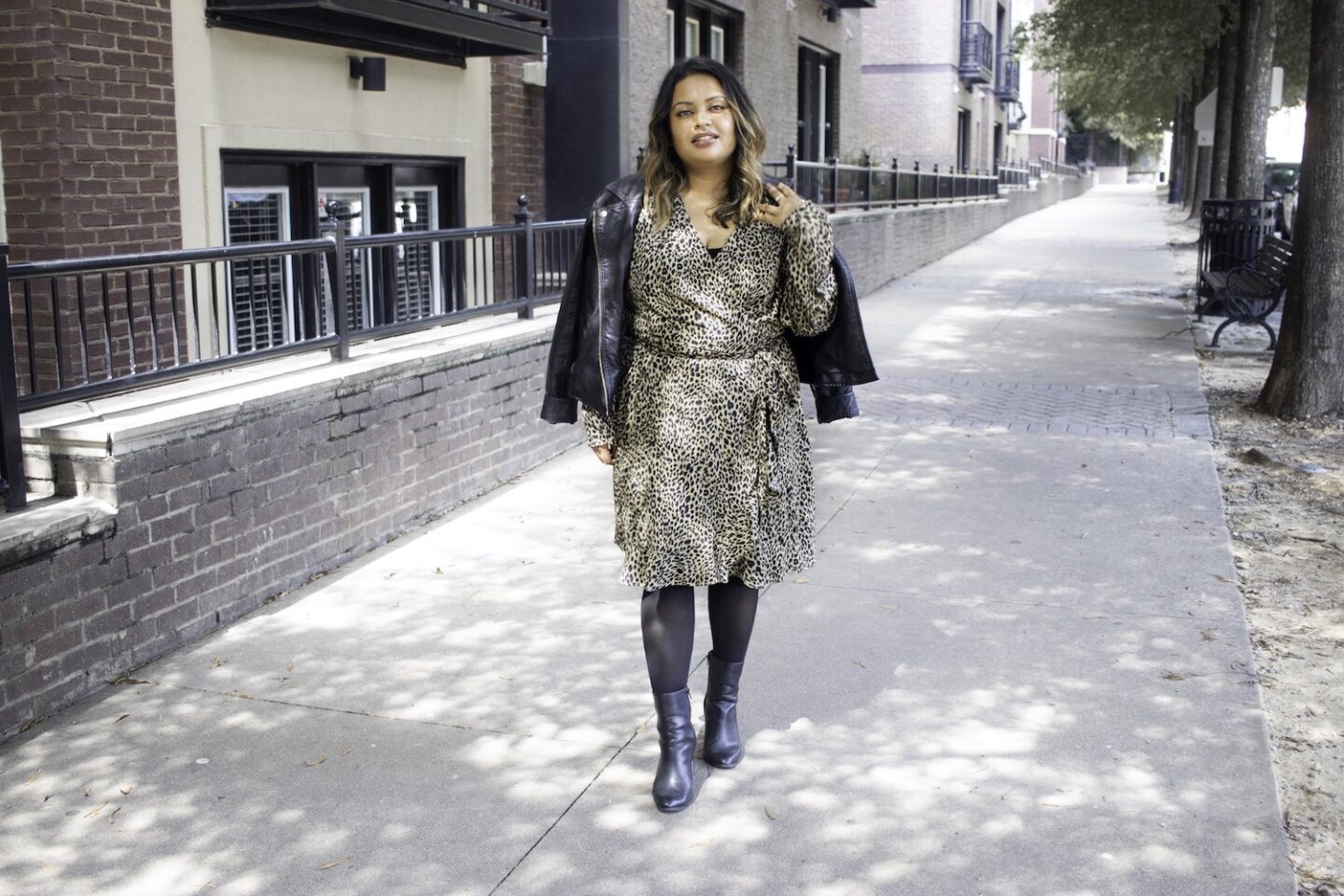
Wrap dresses. The key qualifier: a wrap dress needs enough fabric in the bodice to actually wrap without pulling open at the chest, and the tie needs to hit at your true waist or slightly above it — not at the belly. The wrap creates a V-neckline (good for opening up the chest area) and the tie creates the illusion of a waist. This works. The caveat: cheap wrap dresses with very little fabric don’t work, you need enough coverage that you’re not constantly adjusting. And the fabric needs some weight. Flimsy chiffon wrap dresses will cling and shift in ways that are annoying.
Empire waist dresses. The empire waist sits right below the bust — the highest, smallest part of the torso on most apple shapes — and then flows loose from there. Empire waist skims over the belly completely, the flow creates volume in the lower half, and the fit-at-the-bust moment is often the most flattering fit point for apple shapes.
Maxi dresses with structure at the top. A maxi dress that has a fitted or semi-fitted top (not skin-tight, just held) and then flows into a wide skirt creates the balancing effect we want. Upper body is held, lower body has volume. Avoid maxis in very clingy fabric that hugs every inch the whole way down.
Usally a problem for apple shapes are body-cons and straight-cut minis. Both require the fabric to travel over the belly with no structure and no flow, which means they end up revealing every contour. You can wear them if you want, but they require a very specific kind of confidence.
PART 5: The Apple Shape Body Zone Breakdown
Zone 1: Shoulders and Chest
Many apple shapes carry a lot of volume in the chest and shoulders. This is where structured shoulders actually help because a clearly defined shoulder gives the top half of your outfit a strong, intentional shape.
For necklines: yes, V-necks and scoop necks work because they open up the chest area and create visual length. But U-necks, square necklines, and even high necks can work too if the rest of the outfit is doing its job. Don’t let the neckline be the only thing you’re managing.
Zone 2: The Midsection
The belly zone is where most style advice tells you to hide, minimize, and camouflage. I want to offer a different framing: the belly is the center of your visual field in an outfit. Everything else orbits it. The goal isn’t to hide it, it’s to style the rest of the outfit in a way that makes the whole look balanced and intentional.
Practically: avoid cinching directly at the belly (belts at the belly button are almost always unflattering on apple shapes). Cinch at the narrowest point you have — for most of us, that’s just below the bust. Flowy fabrics over the belly are your friend, they skim rather than reveal. Structured fabrics that hold away from the body are also your friend. The enemy is thin, clinging fabric that travels to every contour.
Zone 3: Legs and Hips
For most apple shapes, the legs and hips are the part of the body that has the most styling flexibility. We often have slimmer legs relative to our upper body — which means we can wear a wider range of pant silhouettes than we’re told. A midi skirt with a fitted top can be an incredible apple-shape look because the legs are visible and add visual balance. Don’t cover your legs out of habit. Show off your legs!
PART 6: Apple Shape Style Rules That Are Completely Wrong
Myth: “Always wear dark colors on top” Wearing dark colors on top as a rule just means your whole wardrobe becomes dark tops and you never wear the things you actually want to wear. The color of your top is not the main event. The silhouette and the balance are. Wear color (only if you want to that is). Wear prints on top if you want them. The outfit will be fine if everything else is balanced.
Myth: “Avoid horizontal stripes” The horizontal stripes rule comes from the idea that stripes “widen” whatever they’re on. Trust me, I fell for this too. For apple shapes, if you want to widen your lower half to create balance, horizontal stripes on a skirt or wide-leg trouser can actually serve you. Context matters. Blanket rules about patterns are lazy advice.
Myth: “Never tuck in your top” The tuck, done right, can be incredible on apple shapes. A half-tuck into a high-rise wide-leg trouser? Exactly the right kind of intentional. The rule should be: tuck strategically, into high-rise bottoms, and if you’re doing a full tuck, make sure the waistband hits above or at the belly, not below it. The tuck isn’t the problem, the low-rise waistband is.
PART 7: How to Shop as an Apple Shape, Size 14-16
Shopping as an apple shape in the size 14-16 range means navigating a few specific challenges:
The waistband problem: Buy pants that fit the widest part of your lower belly and plan to have the waistband taken in if needed. A tailor taking in a waistband costs almost nothing and transforms how pants fit. This is not a workaround, it’s just how clothes work for bodies that don’t match the industry’s draft specs. Most bodies don’t.
The “model is a different body type” problem: Do not evaluate how something will look on you based on how it looks on the model if the model is not apple-shaped and size 14-16. I cannot stress this enough. The drape, the fall, the fit will all look different on your body, so check the measurements. Read the reviews from people who have your size and shape. Find apple-shape specific creators and look at their try-ons.
The “this fits my belly but nowhere else” problem: In tops and dresses, size for your bust and belly — those are the hardest to accommodate — and tailor or alter everything else. If a dress fits your chest and belly but the shoulders are big, a tailor can fix shoulders. If pants fit your belly but are huge in the legs, a tailor can taper them. Buy for the parts that can’t be altered; alter the parts that can.
The Apple Shape Shopping Rule: Shop in this order: does it fit the non-negotiable parts of your body? (For tops/dresses: bust, belly, shoulders. For bottoms: the widest part of your hips/belly.) If yes, everything else can be adjusted. If no, move on. Never buy something hoping it’ll somehow fit when you get home.
PART 8: The Formula for Apple Shape Outfits That Actually Work
Here are the apple shape outfit formulas I return to constantly. Mix and match these because they work by applying the principles, not breaking them.
Formula 1 The Workhorse: High-rise wide-leg trousers + structured top with a hem that hits at the hip or slightly above + pointed-toe flats or heeled mule. The wide leg does the balancing work. The structured top stays put. The pointed toe gives length to the leg. This is basically an all-weather, all-occasion uniform.
Formula 2 The Dress: Empire waist midi dress + chunky sandal or block-heel boot. No layering needed. The empire waist fits above the belly, flows over it, the midi length gives the look weight in the lower half. Done.
Formula 3 The Jean Look: High-rise wide-leg jeans + flowy blouse that ends just below the hip, or fully tucked in, + loafer or ankle boot. The straight leg is elongating, the half-tuck suggests structure without requiring it, the loafer or boot grounds the look.
Formula 4 The Statement Skirt: Midi or maxi flared skirt and fitted (not tight), top tucked in or ending at waist, + heals or sandal. Let the skirt be the story. Apple shapes can absolutely wear statement skirts, let the volume at the bottom is do the balancing work we need.
Formula 5 The Casual: Wide-leg jogger, wide-leg balloon, or pull-on wide-leg linen pant + structured oversized blazer + sneaker. Comfortable but intentional. The blazer creates the shoulder structure, the wide leg does the balancing, the whole look is pulled together without being precious about it.
In Closing, The Point of All of This
Here’s what I want to leave you with: you are not hard to dress. You are not a body that needs apologizing for or working around. You’ve been given advice designed for a different body type, and it didn’t work, and that’s the content gap I’m here to fill, through my own experience.
Apple Shape Files is specifically for apple-shaped women, size 14-16, who want style advice from someone who has this body and has been figuring it out in real time. Every episode goes deeper into a specific part of the wardrobe. All of it grounded in the apple shape framework, all of it size 14-16 specific.
If this helped you, save it. Send it to the friend who has been struggling with the same things. And come back for more apple shape fashion content!
#AppleShapeFiles#AppleShapeStyle#AppleShapedBody#PlusSizeFashion#Size14Fashion#AppleShapeOutfit#PlusSizeStyle#WhatToWearAppleShape
Related blog post: Plus Size Fashion Do’s and Don’ts